2026 Federal Contracting Update: Key Regulatory Shifts and SAM.gov Requirements
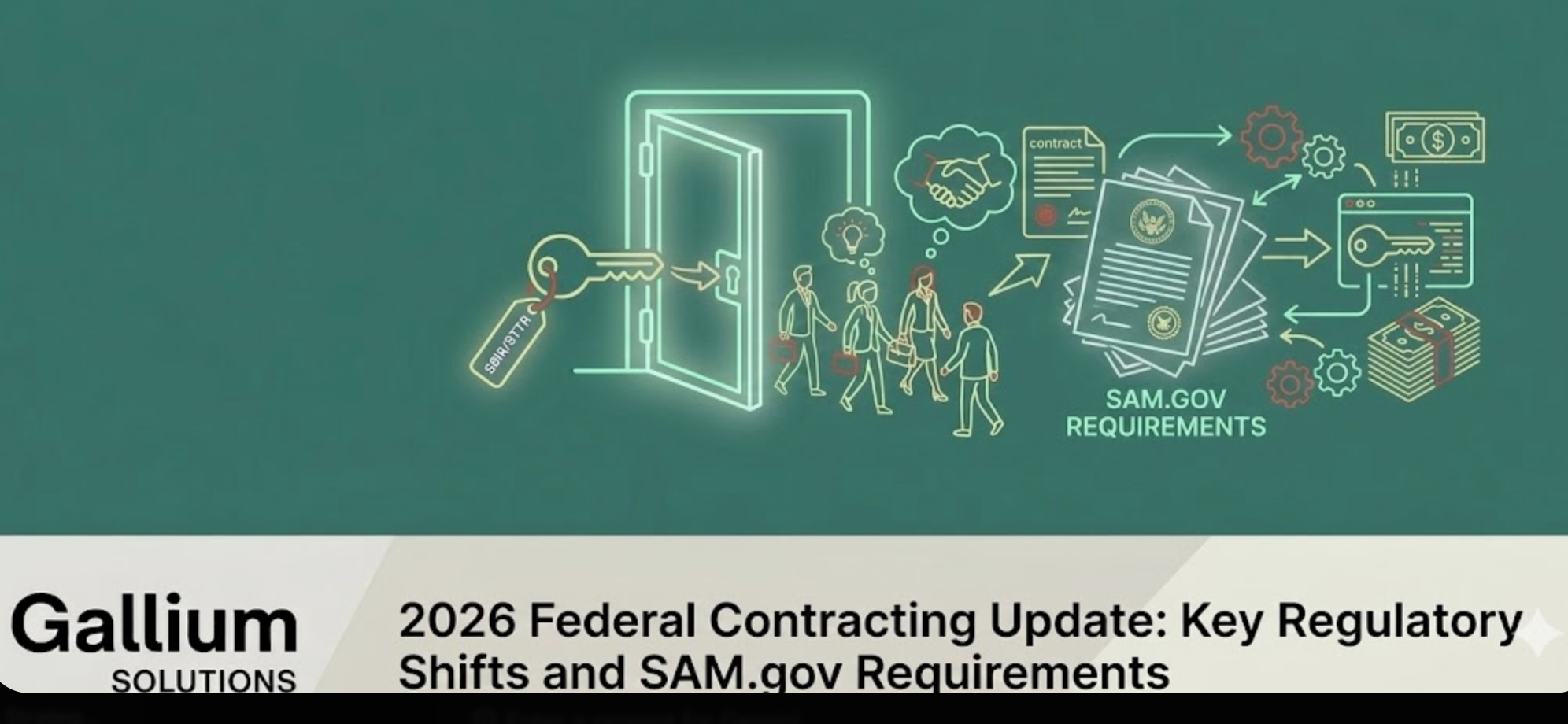
The federal procurement environment in 2026 is defined by the implementation of the Revolutionary FAR Overhaul (RFO) and the full-scale integration of the Cybersecurity Maturity Model Certification (CMMC). For entities seeking to maintain or establish eligibility for federal awards, understanding the technical requirements of these updates is mandatory for successful SAM.gov registration and contract compliance.
At Gallium Solutions, we monitor these regulatory transitions to provide objective guidance for businesses navigating the System for Award Management.
The 2026 SAM.gov Validation Protocol
In 2026, the General Services Administration (GSA) has standardized the entity validation process to reduce data discrepancies across federal systems. The following technical requirements are now standard for all new registrations and annual renewals.
Legal Entity Consistency
SAM.gov now utilizes real-time API verification with the Internal Revenue Service (IRS) and state-level registries. Registration requires an exact match between the Legal Business Name and the Taxpayer Identification Number (TIN). Even minor punctuation differences (e.g., "Company, Inc." vs. "Company Inc.") trigger a manual review process that can extend validation timelines by 15–30 business days.
Unique Entity ID (UEI) and Physical Presence
The UEI remains the primary identifier for federal entities. Per 2026 guidelines, entities must provide verifiable proof of physical presence at the registered address. P.O. Boxes and virtual offices are categorized as "high-risk" and require additional documentation, such as utility bills or lease agreements, to be uploaded to the Federal Service Desk (FSD.gov).
Regulatory Impact of the Revolutionary FAR Overhaul (RFO)
The RFO represents a significant restructuring of the Federal Acquisition Regulation. This overhaul has introduced specific data fields in SAM.gov that entities must complete to remain eligible for specific contract types.
Commercial Solutions Openings (CSO)
The RFO has expanded the use of CSOs under FAR Part 12. To be considered for these streamlined acquisitions, entities must accurately categorize their offerings under the "Commercial Items" assertion within their SAM profile. This assertion is a prerequisite for agencies utilizing fast-track procurement authorities.
Modular Contracting and NAICS Mapping
Current federal directives favor modular contracting to increase agility. Entities are advised to map their capabilities to specific North American Industry Classification System (NAICS) codes that reflect modular deliverables. In 2026, agencies frequently utilize automated filters that prioritize entities with a history of performance in specific, narrow NAICS categories over broad, general classifications.
Mandatory Cybersecurity Certifications (CMMC 1.0)
As of late 2025, the CMMC program has moved into its first mandatory implementation phase. For defense contractors and subcontractors, compliance data must now be synchronized with SAM.gov via the Supplier Performance Risk System (SPRS).
Level 1 and Level 2 Attestations
Entities must indicate their current CMMC status within the "Representations and Certifications" section of SAM.
- Level 1 (Foundational): Requires annual self-assessments submitted to SPRS.
- Level 2 (Advanced): For entities handling Controlled Unclassified Information (CUI), third-party or government-led assessments are required for contract award eligibility.
Supply Chain Risk Management (SCRM)
New 2026 provisions require contractors to certify the origin of critical components. Specifically, compliance with Section 889 regarding prohibited telecommunications and recent executive orders regarding foreign-made semiconductors must be verified during the registration process.
Essential Maintenance and Renewal Timelines
A SAM.gov registration is valid for 12 months. However, the 2026 processing environment suggests a more proactive approach to avoid lapses in eligibility.
The 60-Day Renewal Window
Due to the increased verification steps required by the RFO and CMMC integration, the GSA recommends initiating renewals at least 60 days prior to expiration. A lapsed registration results in an immediate suspension of payment processing for active contracts and renders the entity ineligible for new awards.
Notarized Administrator Letters
The requirement for a notarized letter designating the Entity Administrator remains in effect. These must be submitted on official company letterhead and uploaded to the Federal Service Desk. Registrations that lack an approved letter within 30 days of online submission are subject to deletion.
Technical Support and Compliance with Gallium Solutions
Navigating the 2026 federal landscape requires precise adherence to evolving administrative and cybersecurity standards. Gallium Solutions provides objective, technical expertise in SAM.gov registration, GSA Schedule management, and federal compliance audits.