SBIR/STTR Programs Just Reopened After 5-Month Shutdown: What Your Business Needs to Know Right Now
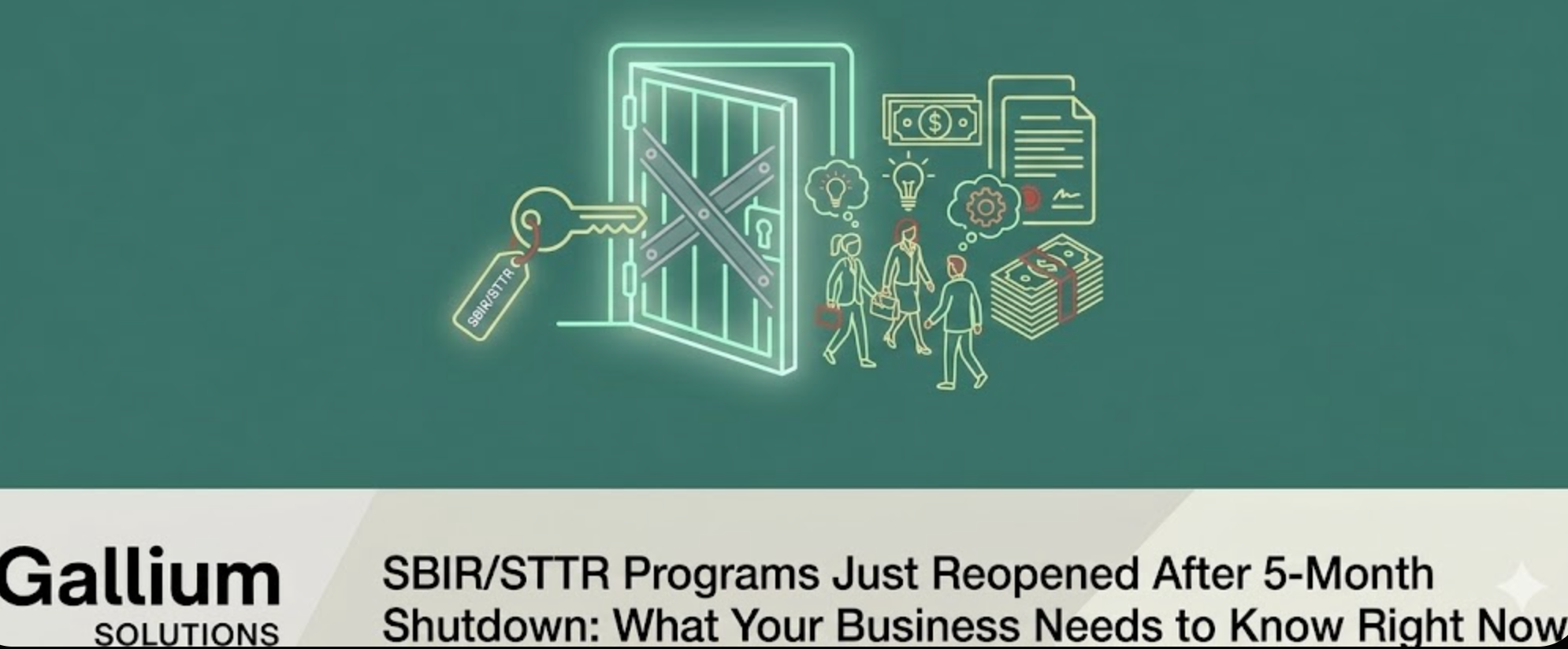
Small Business Innovation Research (SBIR) and Small Business Technology Transfer (STTR) programs officially reopened after a contentious 5-month shutdown that left thousands of small businesses in limbo.
The programs expired on September 30, 2025, creating a funding freeze that halted new solicitations, delayed existing awards, and left America's innovation ecosystem in uncertainty. After months of negotiations between Senators Edward Markey (D-Mass.) and Joni Ernst (R-Iowa), Congress passed the Small Business Innovation and Economic Security Act, restoring $4+ billion in annual R&D funding to small businesses.
If your business depends on SBIR/STTR funding, pursues federal R&D opportunities, or has been waiting through this shutdown, here's exactly what you need to know about the restart, what changed, and how to position for opportunities now.
What Just Happened: The SBIR/STTR Shutdown Timeline
The shutdown wasn't a surprise. It was a collision between competing visions for America's premier small business innovation programs.
September 30, 2025: Programs Expire
Congressional authority for SBIR/STTR ended. Senator Ernst blocked short-term extensions while pushing for major reforms through her INNOVATE Act. The House passed a clean one-year extension unanimously. The Senate couldn't agree.
Result: Programs went dark. Agencies couldn't issue new solicitations. Approximately 4,000 companies per year that rely on SBIR/STTR funding were stuck in limbo.
October 2025 - January 2026: The Waiting Game
The shutdown dragged through Q4 2025 and into 2026. Small businesses couldn't apply for new awards. Existing projects continued but faced uncertainty about continuation funding. The innovation ecosystem held its breath.
Historical precedent suggested eventual reauthorization. The 2009-2011 lapse lasted over two years. This time, pressure from industry groups, research institutions, and economic concerns forced faster action.
February 25, 2026: Deal Reached
Senators Markey and Ernst reached compromise. The Small Business Innovation and Economic Security Act was introduced, fast-tracked through the Senate, and sent to the House for expected quick passage and presidential signature.
Programs reauthorized through September 30, 2031. Funding restored. The innovation engine restarted.
What Changed: Key Provisions in the Reauthorization
The new legislation isn't just an extension. It includes specific reforms and improvements that affect how businesses pursue and receive SBIR/STTR funding.
Extended Timeline Through 2031
The programs now have six years of stability through September 30, 2031. This provides long-term certainty for strategic planning. Previous reauthorizations created shorter-term uncertainty that disrupted multi-year research planning.
For businesses, this means you can build multi-phase strategies without worrying about another near-term expiration.
Improved Data Collection Requirements
The reauthorization includes better tracking requirements for direct-to-Phase-II awards, Phase III transitions, and subcontracting data. Agencies must now document and report commercialization outcomes more thoroughly.
This transparency benefits businesses by providing clearer data on success patterns, agency priorities, and transition pathways. You can make more informed decisions about which agencies and topics align with your commercialization strategy.
Commercialization Focus Strengthened
The legislation emphasizes commercialization outcomes even more heavily than previous versions. Agencies will face increased pressure to demonstrate that SBIR/STTR investments transition to operational use and private sector success.
For businesses, this means proposals need credible commercialization plans from Phase I forward. The days of treating SBIR as pure research funding are over. Agencies want technologies that deploy, not papers that publish.
What Didn't Change (The INNOVATE Act Was Blocked)
Critically, Senator Ernst's INNOVATE Act reforms were NOT included. The contentious provisions that would have fundamentally restructured the programs didn't make it into final legislation.
The INNOVATE Act would have imposed a $75 million lifetime funding cap per organization, limited principal investigators to one application per solicitation, capped organizations at three applications per solicitation, and created new Phase 1A awards for new entrants.
These restrictions were blocked. The programs maintain their current structure and accessibility.
What This Means for Your Business: Immediate Action Items
The restart creates both opportunities and challenges. Here's exactly what you need to do based on your current situation.
If You Had Phase I or Phase II Awards in Progress
Existing contracts should continue without interruption. Agencies were instructed to honor ongoing obligations during the lapse. However, verify your specific award status with your program officer.
For continuation funding and Phase II conversions that were pending during the shutdown, expect processing delays as agencies work through backlogs. Proactive communication with program managers is essential.
If you completed Phase I during the shutdown and were planning Phase II submission, monitor agency announcements for updated solicitation schedules. Timeline expectations have shifted due to the five-month gap.
If You Were Preparing Proposals When Programs Shut Down
Dust off those materials. Agencies will begin issuing solicitations, but don't expect immediate flood of opportunities. There will be a ramp-up period as agencies reactivate their SBIR/STTR programs and update topics for 2026 priorities.
Review and update your proposals. Five months have passed. Your technical approach might need refinement. Your commercialization landscape may have shifted. Your team composition could have changed.
Check agency websites for updated solicitation schedules. The Department of Defense, National Institutes of Health, Department of Energy, NASA, and National Science Foundation will each publish their restart timelines independently.
If You're New to SBIR/STTR
Now is actually an excellent time to enter the programs. The backlog created by the shutdown means agencies will be eager to get awards flowing again. Competition may be temporarily less intense as some businesses shifted focus during the lapse.
However, don't rush unprepared. The restart doesn't lower the quality bar. Agencies still evaluate technical merit, commercialization potential, and team capability rigorously.
Focus on these immediate priorities: Register in SAM.gov if you haven't already (this takes 7-10 business days when done correctly), research agency SBIR/STTR topics aligned with your technology, identify program managers to contact for pre-solicitation guidance, and develop your Phase I technical and commercialization approach.
The businesses that win early post-restart awards will be those who used the shutdown period to prepare thoroughly.
If You're Considering SBIR/STTR for the First Time
The 2031 reauthorization provides six years of funding certainty. This makes SBIR/STTR a more reliable business development channel than during previous shorter reauthorization periods.
Understand that SBIR/STTR isn't quick money. Phase I is typically 6-12 months of technical proof-of-concept work with $250,000-$300,000 in funding. Phase II is 24 months of prototype development with $1.5-$2 million in funding. Phase III is transition to production with variable funding amounts.
Timeline from Phase I proposal to Phase II award is typically 18-24 months. From Phase I proposal to commercialized product is often 4-6 years. This is strategic, patient capital for technology development, not working capital for operational expenses.
Agency-Specific Considerations: Where to Focus
Not all agencies restart at the same pace or with the same priorities. Strategic focus matters.
Department of Defense: Largest SBIR Budget
DoD manages the largest SBIR/STTR budget across all agencies. Expect DoD to prioritize rapid restart to address critical defense technology gaps.
Focus areas likely to see immediate solicitations: AI and machine learning for military applications, autonomous systems and unmanned platforms, cybersecurity and zero-trust architectures, advanced materials and manufacturing, and directed energy and hypersonics.
DoD uses multiple pathways including traditional service-specific SBIR programs (Air Force, Army, Navy, Space Force), Defense Health Program for medical technologies, Missile Defense Agency for defensive systems, and Special Operations Command for specialized capabilities.
National Institutes of Health: Healthcare Innovation
NIH SBIR/STTR funding supports healthcare and life sciences innovation. The shutdown particularly impacted biotech and medical device companies with lengthy development timelines.
Expect NIH to emphasize healthcare priorities elevated during and after COVID-19, medical diagnostics and personalized medicine, drug development and delivery systems, digital health and AI-assisted medical applications, and health disparities and underserved populations.
Department of Energy: Clean Tech and Advanced Energy
DOE SBIR/STTR supports energy innovation and national lab collaborations. Clean energy transition and grid modernization are policy priorities that will drive post-restart funding.
Focus areas: Advanced energy storage and battery technologies, grid resilience and renewable integration, carbon capture and climate technologies, advanced nuclear and fusion energy, and critical materials and supply chain security.
NASA: Space and Aeronautics
NASA SBIR/STTR supports space exploration and aeronautics technologies. The Artemis moon program and Mars missions drive technology priorities.
Expect solicitations in space systems and exploration technologies, in-space manufacturing and resource utilization, advanced propulsion systems, autonomous systems for space operations, and Earth observation and climate monitoring.
National Science Foundation: Fundamental Research
NSF SBIR/STTR supports fundamental research across scientific disciplines with commercial potential. NSF is often more receptive to early-stage, higher-risk technologies than other agencies.
NSF uses a different model with fast-track options that combine Phase I and Phase II into streamlined processes. Good for companies with mature technical approaches seeking faster funding decisions.
The Commercialization Imperative: What Agencies Actually Want
The restart coincides with intensified focus on commercialization outcomes. Understanding this shift is critical to winning awards.
From Research to Results
Historical criticism of SBIR/STTR centered on companies that received multiple awards without commercializing technologies. The programs were characterized as funding research that never reached markets or operational use.
The 2026 reauthorization doubles down on commercialization requirements. Agencies will increasingly evaluate proposals based on clear pathways from research to deployment.
Your Phase I proposal must articulate exactly how Phase I results lead to Phase II development, how Phase II prototypes transition to Phase III production, who your customers are beyond the government, what your go-to-market strategy looks like, and how private sector investment will scale the technology.
What Commercialization Actually Means
Commercialization doesn't just mean selling products. It includes technology transition to prime contractors for integration into larger systems, licensing intellectual property to established companies for production, attracting private investment based on government-validated technology, and deployment within government agencies as operational capabilities.
The key is demonstrating that your technology doesn't end with a final report. It continues into real-world application.
Building Credible Commercialization Plans
Weak commercialization sections sink otherwise strong technical proposals. Agencies can spot generic commercialization boilerplate immediately.
Strong commercialization plans include specific potential customers you've already engaged, realistic market size analysis with defensible assumptions, identified competitors and your differentiation strategy, partnerships or teaming arrangements already established, intellectual property strategy for protection and licensing, regulatory pathway if applicable to your technology, and funding strategy beyond SBIR/STTR including private investment.
Generic statements like "we will commercialize through direct sales and licensing" without supporting detail won't win in the post-restart competitive environment.
Strategic Positioning: How to Win in the New Environment
The restart creates temporary competitive advantages for businesses that move strategically.
First-Mover Advantage Is Real But Brief
Agencies want to get funding flowing again quickly. The businesses that submit strong proposals to early solicitations face less competition than they will six months from now when the market fully rebounds.
However, first-mover advantage only applies to prepared businesses. Rushing weak proposals doesn't improve win probability. The advantage goes to businesses that used the shutdown to prepare and can execute immediately when solicitations drop.
Relationship Building Matters More Than Ever
During the shutdown, program managers continued their jobs. They identified technology gaps, planned future solicitations, and maintained networks with industry.
The businesses that stayed engaged during the shutdown, attended virtual industry events, scheduled informational meetings with program officers, and demonstrated continued interest are now known quantities.
When solicitations reopen, program managers remember who stayed engaged and who disappeared. Build or rebuild those relationships now.
Demonstrate Resilience and Commitment
The shutdown tested commitment to government R&D funding. Companies that pursued alternative funding, continued technology development, maintained team capability, and remained engaged with agencies demonstrated resilience.
That resilience signals to agencies that you're serious about commercialization. Companies that treat SBIR/STTR as their only funding strategy are higher risk than companies building diversified funding that includes SBIR/STTR as one component.
Common Mistakes to Avoid Post-Restart
The restart will create predictable patterns of business mistakes. Avoid these.
Mistake 1: Rushing Unprepared Proposals
The eagerness to access funding again will drive businesses to submit before they're ready. Agencies aren't lowering quality standards because of the restart.
A strong proposal submitted two months from now wins. A rushed proposal submitted immediately loses. Take time to prepare properly.
Mistake 2: Ignoring Changed Commercialization Standards
If your approach to SBIR/STTR hasn't evolved to address heightened commercialization focus, you'll struggle. Review previous proposals with honest assessment of whether your commercialization sections would be competitive in 2026.
Mistake 3: Applying to Wrong Agencies
Not all agencies buy the same technologies or evaluate the same criteria. DoD priorities differ from NIH priorities which differ from DOE priorities.
Generic proposals submitted to multiple agencies without customization signal poor understanding of agency missions. Focus on 2-3 agencies where your technology genuinely aligns with their specific problems.
Mistake 4: Treating SBIR/STTR as Working Capital
SBIR/STTR funds technology development, not operational expenses or general business development. Companies that treat SBIR awards as general revenue rather than specific R&D projects struggle with execution and deliverables.
If you need working capital, SBIR/STTR isn't the right funding source. If you need R&D funding to develop specific technologies with clear paths to commercialization, SBIR/STTR is perfect.
Mistake 5: Ignoring Compliance Requirements
SBIR/STTR awards come with federal contracting compliance requirements including accounting standards, intellectual property rules, reporting obligations, and audit requirements.
Businesses that ignore compliance until after award face expensive corrections and potential contract termination. Build compliance into your planning from the proposal stage.
Your Action Plan: Next 30-60-90 Days
Here's exactly what to do in each timeframe to position for post-restart success.
Next 30 Days: Foundation Building
Verify SAM.gov registration is current and accurate. The restart will drive traffic to SAM. Ensure you're properly registered and your profile is optimized with comprehensive NAICS codes and keyword-rich capability descriptions.
Research agency SBIR/STTR websites for restart announcements and updated solicitation schedules. Subscribe to agency notification lists. Join agency-hosted webinars about program restart.
Identify 2-3 target agencies aligned with your technology. Review their past SBIR/STTR topics to understand funding patterns and priorities.
Develop or update your core SBIR materials including technical capabilities overview, commercialization strategy framework, team qualifications and past performance, and technology readiness level assessment.
Days 31-60: Relationship and Intelligence
Schedule informational meetings with program managers at target agencies. Don't pitch. Listen to their priorities and technology gaps. Ask about restart timelines and upcoming topics.
Attend industry days and pre-solicitation conferences. These events provide critical intelligence about agency priorities and evaluation criteria.
Join SBIR/STTR-focused groups and communities like Small Business Technology Council, regional SBIR/STTR support networks, and industry-specific groups (biotech associations, defense tech forums, energy innovation councils).
Review your competition. Who won awards in your technology area from your target agencies? What differentiated their approaches? Where are gaps your technology can fill?
Days 61-90: Proposal Development
When solicitations drop for your target agencies, develop focused proposals. Don't spray and pray across dozens of agencies. Target 3-5 high-probability opportunities where you have genuine technical and commercialization advantages.
Work with proposal writers experienced in SBIR/STTR if needed. The format and evaluation criteria are specific. Generic grant writers often don't understand SBIR/STTR nuances.
Engage potential Phase III partners and customers. Having letters of support from companies that would license your technology or agencies that would deploy it strengthens commercialization credibility.
Prepare for the long game. Even with restart, Phase I awards typically come 3-6 months after solicitation closes. Phase II is another 12-18 months out. Build patience into your strategy.
The Bottom Line: SBIR/STTR Is Back, But Different
The Small Business Innovation Research and Small Business Technology Transfer programs reopening is unequivocally good news for America's innovation ecosystem. Four billion dollars in annual R&D funding is flowing again to small businesses developing critical technologies.
But the restart isn't a return to normal. The programs are different now. The five-month shutdown, the political negotiations, and the increased commercialization focus have shifted how agencies evaluate proposals and what they expect from awardees.
The businesses that succeed in post-restart SBIR/STTR will be those that understand these shifts and adapt accordingly. Companies that approach 2026 SBIR/STTR the way they approached 2024 SBIR/STTR will struggle.
The opportunity is real. The competition is intense. The requirements are rigorous. Success goes to businesses that prepare strategically, propose thoughtfully, and execute flawlessly.
At Gallium Solutions, we help businesses navigate the complete government funding landscape including SBIR/STTR positioning and proposal development. If you're considering pursuing SBIR/STTR funding post-restart, schedule a strategy session to discuss your technology, assess agency alignment, and develop a realistic pursuit strategy that maximizes your probability of success.