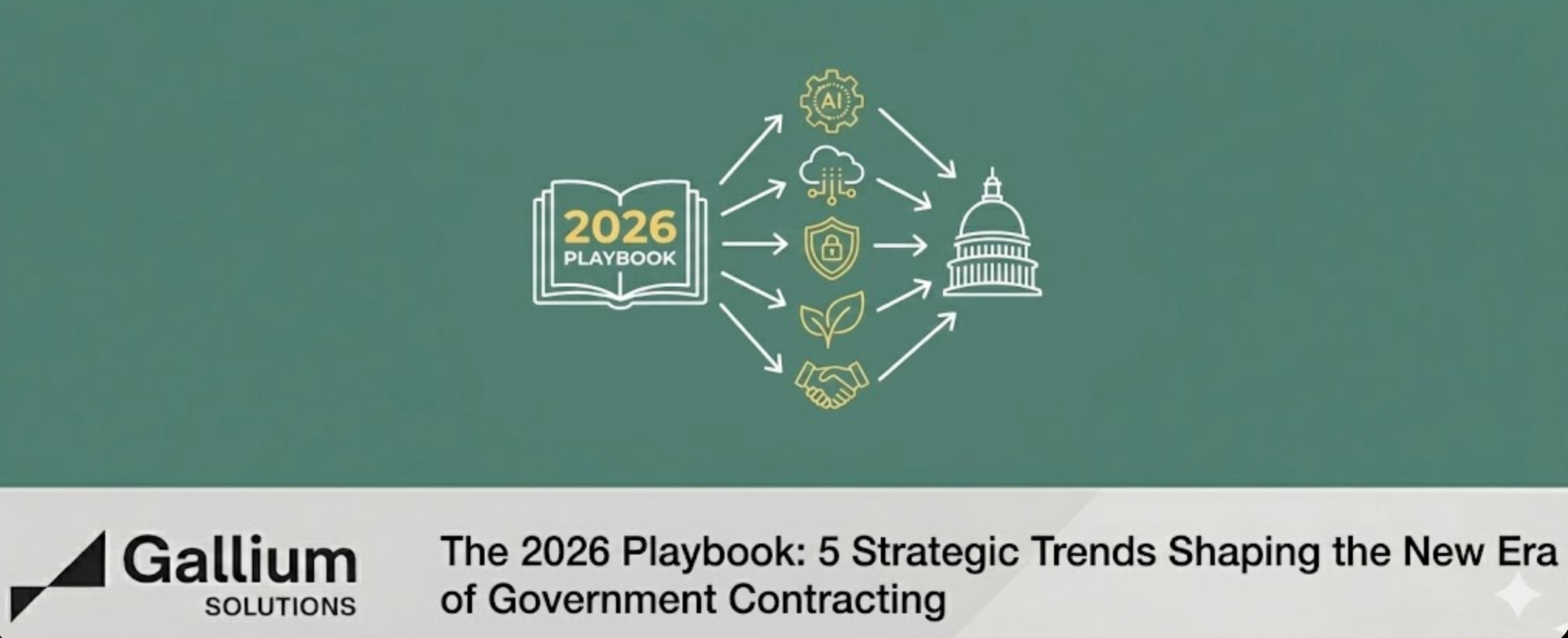
The 2026 Playbook: 5 Strategic Trends Shaping the New Era of Government Contracting
As we turn the page to 2026, the federal marketplace is undergoing its most aggressive transformation in decades. The days of slow-rolling "cost-plus" contracts are fading. In their place is a new operating system defined by the Fiscal Year 2026 NDAA, the Department of Government Efficiency (DOGE), and a relentless focus on speed.
For contractors, 2026 will not be about who can write the longest proposal, but who can deliver the fastest solution. Here are the five strategic trends that will define your pipeline this year.
Trend 1: The "Revolutionary FAR Overhaul" (RFO) is Live
For years, we heard rumors of a massive simplification of the Federal Acquisition Regulation (FAR). In 2026, the Revolutionary FAR Overhaul (RFO) is finally moving into rulemaking, but agencies are already adopting its "Commercial-First" spirit.
"Commercial-First" is No Longer Optional
The RFO explicitly instructs Contracting Officers to prioritize commercial solutions over custom government builds.
- The Shift: If a commercial product (SaaS, logistics, hardware) can meet 80% of the requirement, the government must buy it rather than funding a 5-year development cycle for a 100% custom solution.
- The Opportunity: If you have a commercial product, stop trying to "government-ize" it. Pitch it as-is. The RFO gives you the statutory cover to demand a commercial item determination.
Trend 2: The "Golden Dome" & The Space Boom
The FY2026 NDAA authorizes a staggering $925 billion for national defense, but the "winners" in this budget are specific. The biggest winner? Integrated Air and Missile Defense.
Following the "Golden Dome" Money
Congress has mandated a massive integration of missile defense systems, dubbed the "Golden Dome" effort. This is driving billions into:
- Space Systems: Proliferated Low Earth Orbit (pLEO) satellites for missile tracking.
- Integration Services: Software that connects Army radars with Navy shooters.
- Counter-UAS: Drone defense is now a "quality of life" issue for every base commander.
Pro Tip: You don't need to build satellites to win here. The "Ground Segment"—data processing, IT infrastructure, and cybersecurity for these systems—is where the volume of small business contracts will be found.
Trend 3: The "De-Obligation" Drills (The DOGE Effect)
The Department of Government Efficiency (DOGE) is making its mark not just by cutting staff, but by clawing back money. 2026 will be the year of the "De-Obligation Drill."
The "Stale Money" Hunt
Agencies are under pressure to review every active contract. If a program has "unliquidated obligations" (money sitting on a contract that hasn't been spent), it is at high risk of being seized.
- The Risk: If you are an incumbent sitting on a slow-moving contract, wake up. You need to show "burn rate" immediately.
- The Opportunity: Agencies need to move this money fast before DOGE takes it. This creates a surge in end-of-quarter "sweep" contracts for quick-turn deliverables like software licenses, training, and equipment.
Trend 4: The Return of the "Menu" (OASIS+ Phase II)
The era of "Open Market" bidding on SAM.gov is shrinking. To maximize efficiency, agencies are being forced to use Best-in-Class (BIC) vehicles.
Why OASIS+ Phase II Matters
The GSA has re-opened onboarding for OASIS+ Phase II this month. This vehicle is rapidly becoming the "Amazon Prime" for professional services.
- The Reality: If you aren't on a major vehicle (OASIS+, SEWP VI, MAS), you aren't on the menu. Agencies simply do not have the contracting staff to write new standalone contracts for every requirement.
- Action Item: If you missed Phase I, do not miss Phase II. It is a scorecard-based entry, meaning your Past Performance documentation must be flawless.
Trend 5: "Make it Here" (Reshoring is Law)
The 2026 NDAA includes the strictest Domestic Preference rules in history. The concept of "reshoring" has moved from a political slogan to a contractual requirement.
- Critical Minerals: The DoD is aggressively funding the domestic mining and processing of gallium, germanium, and lithium.
- Micro-Electronics: The "Secure Supply Chain" requirements mean that if you can certify your hardware is 100% TAA-compliant (Trade Agreements Act) and free of adversarial components, you can charge a premium.
- The Pivot: Manufacturing contracts are back. The government is issuing grants and contracts just to stand up capacity, regardless of immediate delivery.
Is Your 2026 Strategy Aligned with the Money?
The market in 2026 is richer than ever, but it is moving faster. The contractors who win this year will be the ones who align with the "Efficiency" and "Speed" mandates.
Don't guess where the budget is going. Let Gallium Solutions build your data-driven capture strategy.