How Gallium Solutions Helps AI Companies Win Federal Contracts in 2026
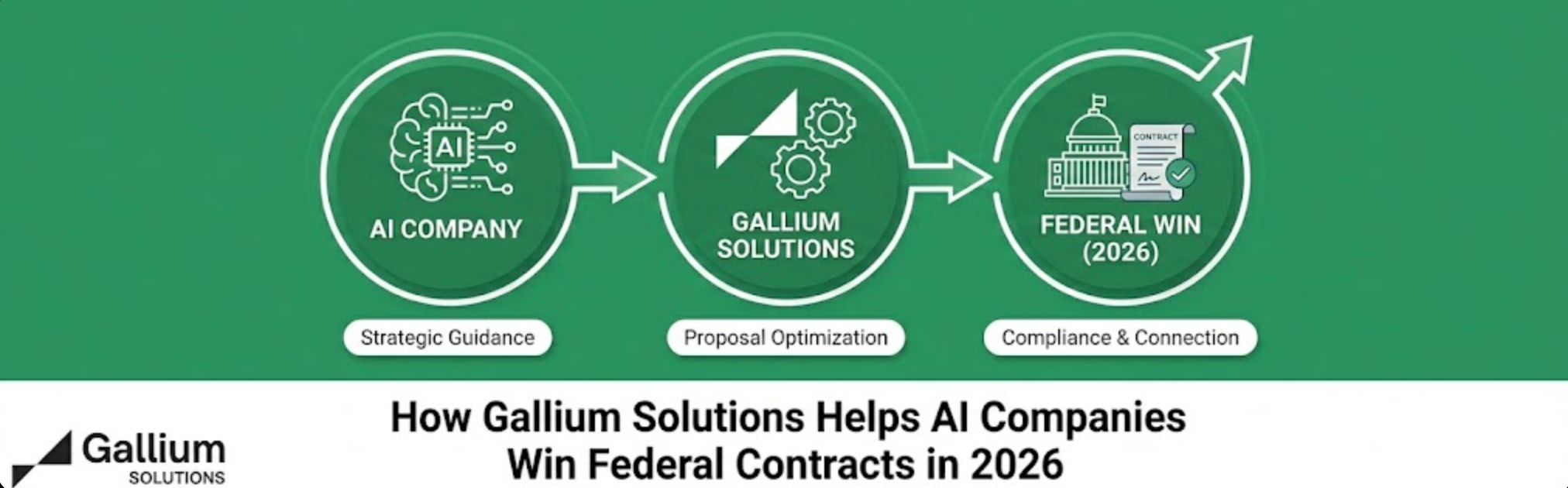
The AI federal contracting market in 2026 presents unprecedented opportunity: $32 billion in recommended funding, agencies desperate for AI solutions, and a landscape where small, innovative companies can compete against established primes.
But here's the reality that most AI companies discover too late: having revolutionary AI technology doesn't translate to winning government contracts.
The graveyard of AI federal contracting is filled with companies that had:
- Cutting-edge machine learning algorithms
- Proven commercial AI deployments
- Venture-backed technical teams
- Impressive product demonstrations
What they didn't have was strategic alignment with agency priorities, understanding of government procurement processes, or relationships with decision-makers who could champion their solutions.
At Gallium Solutions, we've built our entire practice around solving this exact problem: helping AI companies translate technical excellence into government contract wins. Since our founding by Alex Hobson, who redesigned AFWERX programs while on active duty, we've helped companies navigate the complex intersection of AI innovation and federal procurement.
This article explains how we help AI companies like yours capture the 2026 federal AI opportunity—from identifying the right agencies to positioning your technology to winning your first contract and scaling to multi-million dollar awards.
The AI Federal Contracting Challenge: Why Technical Excellence Isn't Enough
Before explaining how we help, let's address why AI companies struggle with federal contracting in the first place.
Challenge 1: The Alignment Gap
The Problem: Your AI can do amazing things. You've built natural language processing that exceeds GPT-4 performance on domain-specific tasks. Your computer vision detects objects with 99.3% accuracy. Your predictive models forecast with unprecedented precision.
None of that matters if it doesn't align with what agencies are actually trying to accomplish.
Federal agencies don't buy AI technology—they buy mission outcomes. A Defense Intelligence Agency program manager doesn't care that your neural network architecture is innovative. They care whether you can reduce intelligence analysis time from 40 hours to 4 hours while maintaining accuracy.
How Gallium Helps: We start every engagement with agency mission alignment assessment. We analyze your AI capabilities against current agency priorities, budget allocations, and strategic plans to identify where genuine alignment exists—not where you hope it exists.
Challenge 2: The Government Speaks a Different Language
The Problem: In commercial markets, you position your AI as "leveraging transformer-based architectures for contextual understanding." In government markets, that description generates blank stares from program managers who need solutions, not technical jargon.
Government procurement officers and program managers come from operational backgrounds, not AI research. They evaluate proposals based on mission impact, not algorithmic sophistication.
How Gallium Helps: We translate AI technical capabilities into mission outcomes. Our team includes former government buyers and program managers who understand both AI technology and government operations. We help you develop capability statements, proposals, and presentations that:
- Lead with mission outcomes, not technical features
- Demonstrate understanding of agency operational constraints
- Position AI as enabler of existing workflows, not disruptor
- Address compliance and security requirements upfront
- Use government procurement language correctly
We've worked with companies where this translation process meant the difference between "technically impressive but not for us" and "exactly what we need, how fast can you start?"
Challenge 3: Finding the Right Opportunities
The Problem: SAM.gov lists thousands of federal contract opportunities. SBIR.gov publishes hundreds of topics across dozens of agencies. How do you identify which opportunities are actually worth pursuing with your limited business development resources?
Most AI companies waste enormous time and proposal budgets chasing opportunities that were never a good fit. They submit SBIR proposals to agencies where they have no relationship, pursue prime contracts they're not qualified for, or respond to RFPs where the incumbent already has the inside track.
How Gallium Helps: We've built sophisticated agency targeting and opportunity identification processes specifically for AI companies:
Agency Profiling: We maintain detailed profiles of federal agencies' AI priorities, budget allocations, decision-makers, incumbent contractors, and procurement patterns. When the Department of Veterans Affairs announces AI initiatives, we know their specific use cases, timeline, and which contracting vehicles they'll likely use.
Opportunity Scoring: We evaluate opportunities based on your specific AI capabilities, past performance, compliance readiness, and competitive landscape. Instead of evaluating 100 opportunities superficially, you evaluate 10 opportunities deeply.
Pipeline Development: We help you build 12-18 month pipelines of qualified opportunities across multiple agencies, creating steady opportunity flow rather than feast-or-famine proposal cycles.
Challenge 4: SBIR/STTR Complexity
The Problem: SBIR/STTR programs should be perfect for AI companies: non-dilutive funding for innovative technologies, with Phase I proving concepts and Phase II developing operational prototypes. Instead, many AI companies find SBIR/STTR confusing, time-consuming, and frustrating.
Common pitfalls include:
- Submitting to wrong agencies or topics
- Failing to understand evaluation criteria
- Inadequate commercialization plans
- Poor Phase I to Phase II conversion rates
- Missing critical agency relationship-building
- Underestimating compliance requirements
How Gallium Helps: SBIR/STTR strategy is one of our core specializations. We provide end-to-end SBIR/STTR support:
Topic Analysis: We evaluate which SBIR topics genuinely align with your AI capabilities and have reasonable win probability. Not all topics are created equal—some are written for incumbent contractors, others represent genuine new opportunities.
Agency Engagement Strategy: We coach you through pre-solicitation engagement with agency technical points of contact, helping you refine your approach based on direct agency feedback.
Proposal Development: We guide proposal development, ensuring your technical approach addresses evaluation criteria while positioning for Phase II conversion and eventual transition to operational use.
Phase II Positioning: Phase I awards are starts, not finishes. We help you execute Phase I with an eye toward Phase II conversion, maintaining agency relationships and demonstrating value throughout.
Transition Planning: The government doesn't want research—they want deployable solutions. We help you develop credible transition plans showing how Phase II results become operational systems.
Challenge 5: Compliance Overwhelm
The Problem: Federal AI contracting brings compliance requirements most AI companies have never encountered:
- Cybersecurity Maturity Model Certification (CMMC)
- NIST AI Risk Management Framework
- Controlled Unclassified Information (CUI) handling
- Data rights and government licensing
- AI bias testing and fairness documentation
- Explainable AI requirements
- Supply chain security verification
For venture-backed AI startups focused on rapid product development, these compliance requirements feel like obstacles designed to slow innovation to a crawl.
How Gallium Helps: We provide compliance roadmap development that prioritizes investments based on target opportunities:
Compliance Assessment: We evaluate your current compliance posture against requirements for target agencies and contract types.
Prioritized Investment: Not all compliance requirements matter equally. We help you identify which certifications and capabilities unlock the most valuable opportunities.
Vendor Connections: We connect you with compliance service providers, security consultants, and certification assessors who understand AI-specific requirements.
Compliance as Competitive Advantage: We position your compliance investments as differentiators rather than burdens. In a market where many AI companies ignore compliance until it's too late, proactive compliance becomes a competitive advantage.
Our AI Federal Contracting Services: What We Actually Do
Understanding the challenges is one thing. Solving them requires specific services and expertise. Here's what working with Gallium Solutions looks like:
Strategic Positioning & Market Assessment
Service Components:
AI Capability Inventory: We document your AI technical capabilities in both technical and mission outcome language, creating positioning that resonates with government buyers.
Agency Targeting: We identify 3-5 agencies where your AI capabilities align with current priorities and budget allocations.
Competitive Landscape Analysis: We analyze who's currently winning AI contracts at target agencies, identifying positioning gaps you can exploit.
Value Proposition Development: We craft agency-specific value propositions that emphasize mission outcomes rather than technical features.
Typical Timeline: 4-6 weeks for comprehensive strategic positioning
Deliverables: Agency target list, competitive analysis, positioning documents, capability statements
SBIR/STTR Program Management
Service Components:
Topic Monitoring & Analysis: We track SBIR/STTR topics across all agencies, identifying opportunities aligned with your capabilities.
Pre-Solicitation Agency Engagement: We coach you through engagement with agency technical points of contact to refine your approach.
Proposal Development Support: We guide proposal structure, technical approach, and commercialization planning.
Evaluation Criteria Optimization: We ensure proposals directly address evaluation criteria and demonstrate understanding of agency priorities.
Phase II Conversion Strategy: We help you position Phase I work for Phase II funding and eventual Phase III transition.
Typical Timeline: Ongoing relationship through solicitation cycles
Opportunity Pipeline Development
Service Components:
12-18 Month Pipeline Building: We develop qualified opportunity pipelines across multiple agencies and contract vehicles.
Opportunity Scoring & Prioritization: We evaluate opportunities based on win probability, strategic value, and resource requirements.
Teaming Partner Identification: We identify and introduce potential teaming partners with complementary capabilities or government relationships.
Proposal Go/No-Go Decision Support: We provide objective analysis helping you decide which opportunities deserve pursuit.
Typical Engagement: Monthly pipeline reviews with quarterly strategy updates
Agency Relationship Development
Service Components:
Program Manager Introductions: We leverage our network to facilitate introductions to key decision-makers at target agencies.
Industry Day Coaching: We prepare you for agency industry days and technical exchange meetings.
Demonstration Strategy: We help you develop and execute demonstration strategies that showcase AI capabilities in mission-relevant contexts.
Ongoing Engagement Plans: We create and manage plans for maintaining agency relationships between solicitations.
Compliance Roadmap Development
Service Components:
Requirements Assessment: We identify compliance requirements for target opportunities.
Prioritized Investment Planning: We sequence compliance investments based on ROI and opportunity timelines.
Vendor Network Access: We connect you with trusted compliance service providers.
Compliance Positioning: We help you market compliance capabilities as competitive advantages.
Our AI-Specific Expertise: Why We're Different
Gallium Solutions isn't a general government contracting consultant that also happens to work with AI companies. We've built specific expertise in the AI federal contracting landscape:
Understanding AI Technology
Our team includes advisors with AI technical backgrounds who understand:
- Different AI architectures and their applications
- Machine learning model development and deployment
- AI performance metrics and evaluation methods
- Common AI technical challenges and limitations
This technical understanding means we can have substantive conversations with your technical teams about capabilities, limitations, and positioning.
Government AI Priorities
We maintain current intelligence on AI priorities across agencies:
- Which agencies are funding which AI use cases
- Budget allocations for AI initiatives
- Key decision-makers and program managers
- Incumbent AI contractors and their positioning
- Emerging AI solicitations and contract vehicles
AI Compliance Requirements
We stay current on evolving AI governance and compliance frameworks:
- OMB guidance on AI procurement and deployment
- Agency-specific AI policies and requirements
- Emerging AI testing and evaluation standards
- Data rights and licensing considerations for AI
The AI Vendor Ecosystem
We maintain relationships with:
- AI compliance and security consultants
- FedRAMP and CMMC assessors familiar with AI systems
- Systems integrators pursuing AI prime contracts
- Government AI program managers and former contracting officers
Working with Gallium: The Process
If you're an AI company considering working with Gallium Solutions, here's what the engagement process looks like:
Initial Consultation (Week 1)
Discovery Session: We conduct comprehensive discussion of your AI technology, current market position, and government contracting goals.
Preliminary Assessment: We provide initial assessment of government contracting fit, target agency recommendations, and strategic approach.
Engagement Planning: We propose specific services and engagement structure based on your situation and goals.
No obligation, no cost for initial consultation
Strategic Positioning (Weeks 2-6)
Deep Dive: Comprehensive analysis of your AI capabilities, competitive positioning, and government market fit.
Agency Research: Detailed research on target agencies including priorities, budgets, decision-makers, and incumbent contractors.
Positioning Development: Creation of government-focused capability statements, value propositions, and agency-specific positioning.
Deliverable: Strategic positioning document with agency targets, competitive analysis, and go-to-market plan.
Opportunity Identification & Pursuit (Ongoing)
Pipeline Development: Monthly identification and scoring of opportunities across target agencies.
Proposal Support: Guidance through proposal development for high-priority opportunities.
Agency Engagement: Facilitation of introductions and relationship development with agency decision-makers.
Performance Tracking: Regular assessment of win rates, pipeline health, and strategy effectiveness.
Typical Engagement Models
Project-Based: Fixed-scope engagements for specific objectives (SBIR proposal, agency positioning, compliance roadmap)
Retainer: Ongoing monthly engagement for continuous pipeline development and opportunity pursuit
Success-Based: Performance-based compensation tied to contract awards (typically combined with base retainer)
Investment & ROI: What It Costs, What It Returns
Government contracting service investments should be evaluated against potential returns. Here's realistic framing:
Typical Investment Levels
Strategic Positioning (One-Time): $15,000-$35,000 for comprehensive positioning and agency targeting
SBIR Proposal Support (Per Proposal): $8,000-$15,000 for full proposal development guidance
Monthly Retainer (Ongoing): $5,000-$12,000/month for continuous pipeline management and opportunity pursuit
Success-Based Fees: 2-5% of first-year contract value for awarded contracts
Expected ROI Timeline
Months 1-3: Strategy development, positioning, agency research—investment phase
Months 4-9: Opportunity pursuit, proposal submissions, agency engagement—active pursuit
Months 10-18: First contract awards, relationship establishment—initial returns
Months 18-36: Pipeline maturity, multiple contract awards—full ROI realization
Government contracting success doesn't happen overnight, but the returns can be extraordinary for companies that approach it strategically.
Is Gallium Right for Your AI Company?
We're not the right fit for every AI company. Here's honest assessment of who we serve best:
Ideal Client Profile
AI Technology Characteristics:
- Proven AI capabilities with commercial validation or research pedigree
- Applications relevant to defense, intelligence, civilian agency, or research missions
- Technology at TRL 4+ (component validation) or higher
- Differentiated approach or performance vs. existing solutions
Company Characteristics:
- $500K-$50M in revenue (we work with pre-revenue startups through established companies)
- Committed to government contracting as strategic growth channel
- Willing to invest in positioning, compliance, and relationship development
- Realistic timeline expectations (12-24 months to meaningful revenue)
Leadership Characteristics:
- Technical founders or executives who understand their AI deeply
- Open to positioning guidance even if it differs from commercial positioning
- Willing to engage directly with government stakeholders
- Patient capital or runway to support government sales cycles
When We're Not the Right Fit
Pure Research/Early Stage: If your AI is purely academic research without clear application path, SBIR/STTR programs might work but prime contracting is premature.
Commercial-Only Focus: If you're unwilling to adapt positioning or products for government requirements, federal contracting will frustrate you.
Unrealistic Expectations: If you expect contract awards in 3-6 months with minimal investment, you'll be disappointed.
Compliance Resistance: If you view cybersecurity, data governance, and compliance as unnecessary obstacles rather than requirements, government contracting isn't for you.
The 2026 AI Federal Opportunity: Act Now
The AI federal contracting market in 2026 represents a once-in-a-generation opportunity for innovative companies. Agencies are desperate for AI solutions, budgets are allocated, and procurement processes are streamlining.
But the companies that capture this opportunity won't be those with the best technology—they'll be those with the best positioning, agency relationships, and strategic approach.
The difference between AI companies that succeed in federal contracting and those that waste time and resources comes down to strategic guidance. The government contracting ecosystem rewards those who understand it and penalizes those who don't.
We've helped companies navigate this landscape successfully. We can help you:
- Identify which agencies are the best fit for your AI capabilities
- Position your technology in language that resonates with government buyers
- Navigate SBIR/STTR programs from Phase I through transition
- Build relationships with decision-makers at target agencies
- Develop compliance capabilities that become competitive advantages
- Build sustainable government contracting businesses
The 2026 federal AI opportunity is here. The question isn't whether to pursue it—it's whether to pursue it strategically or waste time and resources learning expensive lessons.
Ready to explore how Gallium Solutions can help your AI company win federal contracts? Schedule your no-obligation strategy session to discuss your technology, your goals, and whether government contracting is the right growth channel for you.