The Complete Guide to Registering Your Business for Government Contracts in 2026
Over 350,000 entities are currently registered in SAM.gov, competing for their share of the federal government's massive procurement budget. In fiscal year 2024 alone, the government awarded over $150 billion to small businesses—and 2026 projections show continued growth in federal contracting opportunities.
But here's what most business owners don't realize until it's too late: having the capability to perform government work doesn't make you eligible to receive government contracts.
Registration isn't a formality. It's not optional. And it's definitely not something you can rush through the night before a proposal deadline.
Federal registration is your license to do business with the largest buyer in the world. Without proper registration in SAM.gov, with the correct CAGE Code, and the right NAICS code classifications, you're legally ineligible to receive a single dollar of federal funding—regardless of how qualified your business might be.
This comprehensive guide breaks down everything you need to know about registering your business for government contracts in 2026: what's required, how long it takes, common mistakes that disqualify businesses, and how to position yourself not just to be registered, but to be competitive.
Understanding the Federal Registration Ecosystem
Before diving into the how-to, you need to understand what you're actually registering for and why each component matters.
SAM.gov: Your Federal Business License
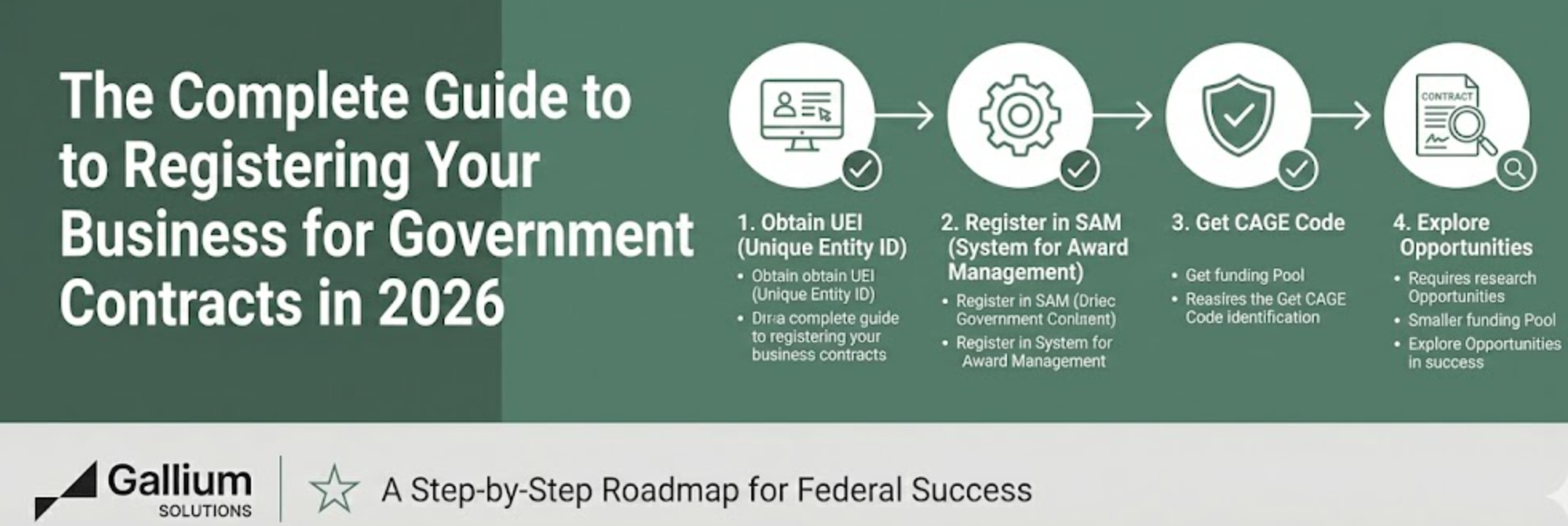
The System for Award Management (SAM.gov) is the official U.S. government database managed by the General Services Administration (GSA). Think of it as your federal business license—without an active SAM registration, you cannot:
- Bid on federal contracts over $25,000
- Receive federal grants
- Get paid for federal work
- Be searchable by government contracting officers
- Participate in most federal procurement activities
SAM.gov replaced multiple legacy systems (CCR, EPPLS, FedReg, and others) into one unified platform. It's completely free—never pay a third-party service for registration, despite the numerous scam companies that charge $300-$3,000 for "mandatory" services.
Critical SAM.gov Facts:
- Registration expires exactly 365 days after activation
- You must be actively registered at proposal submission AND at contract award
- Expired registration makes you immediately ineligible for new awards
- Registration is completely free through SAM.gov
- Processing takes 7-14 business days after submission
UEI: Your Government Fingerprint
In April 2022, the federal government replaced the DUNS number system with the Unique Entity Identifier (UEI). This 12-character alphanumeric code is now generated directly within SAM.gov, eliminating the need to obtain a separate identifier from Dun & Bradstreet.
Your UEI serves as your business's fingerprint in the federal system. According to SAM.gov documentation, the UEI:
- Uniquely identifies your entity across all federal systems
- Links all your government interactions and contract history
- Never expires (unlike SAM registrations, which require annual renewal)
- Is generated automatically when you validate your entity in SAM.gov
You can obtain a UEI without completing a full SAM registration—useful if you only need to report as a sub-awardee. However, to directly bid on federal contracts, you'll need both a UEI and a complete SAM registration.
CAGE Code: Your Commercial Identity
The Commercial and Government Entity (CAGE) Code is a five-character alphanumeric identifier assigned by the Defense Logistics Agency (DLA) to identify a commercial or government entity by unique location.
CAGE codes are required for:
- All Department of Defense contracting
- Most federal prime contracts
- Subcontracting to prime contractors
- Facility security clearances
- Federal grant applications
Key CAGE Code Characteristics:
- Assigned during SAM registration process for U.S. entities
- Takes 7-10 business days to process
- Tied to specific physical locations
- Must be maintained throughout contract life
- Required to be updated within 30 days of any business changes
According to the Federal Acquisition Regulation (FAR), contractors must provide their CAGE code with their offer and include it prominently in proposals. The CAGE code must be for the specific name and location address being proposed.
NAICS Codes: Your Business Classification System
North American Industry Classification System (NAICS) codes are six-digit codes that classify your business activities. These codes are arguably the most strategic elements of your SAM registration because they determine:
- Which contract opportunities appear in your searches
- Your small business size standards for set-aside eligibility
- Your competitive positioning in the federal marketplace
- Whether you qualify for small business programs and certifications
When government contracting officers plan procurements, they assign NAICS codes to each opportunity. Your business only appears in searches if your registered NAICS codes match the opportunity's assigned codes.
Common NAICS Mistakes:
- Selecting only 3-5 codes when you should have 15-25+ based on full capabilities
- Choosing generic, broad codes instead of specific classifications
- Never updating codes as business evolves
- Not understanding how codes affect size standards
The Step-by-Step Registration Process
Now that you understand the components, here's exactly how to register your business for government contracts.
Step 1: Gather Required Documentation (Before You Start)
Registration failures happen most often because businesses don't have proper documentation ready. Before you begin your SAM.gov registration, gather:
Business Information:
- Legal business name (must match IRS records exactly)
- Physical business address (P.O. boxes are NOT accepted)
- Doing Business As (DBA) names if applicable
- Business formation documents (Articles of Incorporation, LLC Agreement, etc.)
- Date business was established
Tax Information:
- Employer Identification Number (EIN) or Tax Identification Number (TIN)
- IRS consent form (proving your business name and address match IRS records)
- Business tax returns may be helpful for verification
Banking Information:
- Bank account number for Electronic Funds Transfer (EFT)
- Bank routing number
- Bank name and address
- Financial institution point of contact
Key Personnel:
- Names and contact information for:
- Executive officers
- Points of contact for contracts
- Electronic Business Point of Contact (eBusiness POC)
- Government Business Point of Contact
Business Classifications:
- Entity type (Corporation, LLC, Sole Proprietor, Partnership, etc.)
- State of incorporation
- Organization structure
- Ownership information (for small business certifications)
Step 2: Create Your SAM.gov Account
Navigate to SAM.gov and create your account:
- Your username and password are managed by Login.gov
- Select "Sign In" on SAM.gov to go to Login.gov
- Set up your Login.gov account with multi-factor authentication
- Return to SAM.gov to complete your profile
Security Note: Login.gov requires multi-factor authentication for security. You'll need either a phone number for text verification or an authentication app.
Step 3: Validate Your Entity and Obtain Your UEI
Before full registration, SAM.gov validates your business information:
- Select "Get Started" and choose "Register Entity"
- Enter your legal business name and physical address
- SAM.gov attempts to validate against authoritative sources
- If validation succeeds, you receive your UEI immediately
- If validation fails, you can create a help ticket with the Federal Service Desk
Common Validation Issues:
- Business name doesn't match IRS records exactly
- Address format doesn't match USPS database
- Entity type selected incorrectly
- New businesses not yet in validation databases
Step 4: Complete Core Data Section
The core data section collects fundamental information about your entity:
Legal Business Information:
- Confirm legal business name and UEI
- Physical address (validated by USPS)
- Mailing address if different
- Congressional district
- Business start date
Entity Structure:
- Business type (Corporation, LLC, Partnership, Sole Proprietor)
- State of incorporation
- Fiscal year end date
- Annual revenue (for size standard determination)
- Number of employees
Contact Information:
- Government Business Point of Contact
- Electronic Business Point of Contact
- Alternate Points of Contact
- Must include name, title, email, and phone
Step 5: CAGE Code Assignment
For U.S. entities, CAGE Code assignment happens automatically during registration:
- Indicate whether you already have a CAGE Code
- If not, select "No" and one will be assigned
- Processing typically takes 7-10 business days
- CAGE Code links to your specific business location
Foreign Entities: Businesses located outside the U.S. must obtain an NCAGE code through the NATO Support and Procurement Agency BEFORE starting SAM registration.
Step 6: Tax Identification Number (TIN) Validation
This is where many registrations get stuck. The IRS TIN validation process verifies:
- Your legal business name matches IRS records exactly
- Your business address matches IRS records
- Your EIN/TIN is valid and active
TIN Validation Failures: The most common cause of SAM registration delays is TIN validation failure. Even minor discrepancies in formatting or abbreviations can trigger failures.
Solutions:
- Use exact business name from IRS correspondence
- Match address format from IRS records
- Contact IRS if records need updating before SAM registration
Step 7: Select NAICS Codes
This is arguably the most strategic part of your registration. You can select up to 1,000 NAICS codes, but strategic selection requires balancing three factors:
Factor 1: Accurate RepresentationSelect codes that genuinely reflect your capabilities. False representation can lead to contract termination and potential fraud charges.
Factor 2: Market OpportunityResearch federal spending patterns in different NAICS categories using USASpending.gov. Some codes have significantly more contract volume than others.
Factor 3: Size StandardsEach NAICS code has different small business size standards (either by revenue or employees). Your primary NAICS code determines your overall size standard classification.
Strategic Approach:
- Select 15-25+ codes covering all your actual capabilities
- Include both broad and specific codes in your industry
- Add codes for capabilities you're developing
- Review and update annually as business evolves
Step 8: Complete Representations and Certifications
This section determines which contract set-asides and special programs you're eligible for:
Core Certifications:
- Small business status
- Woman-Owned Small Business (WOSB)
- Service-Disabled Veteran-Owned Small Business (SDVOSB)
- HUBZone certification
- 8(a) Business Development Program participant
Additional Representations:
- Telecommunications equipment restrictions
- Covered foreign country determination
- Tax liability certification
- Equal opportunity compliance
- Buy American Act compliance
Critical: These certifications carry legal weight. False certifications can result in criminal penalties, contract termination, suspension, and debarment.
Step 9: Electronic Funds Transfer (EFT) Information
To receive payment from the federal government, you must provide banking information:
- Bank account number
- Routing number
- Bank name and address
- Account type (checking or savings)
Validation: Banking information must match your financial institution's records exactly. Coordinate with your bank to ensure accuracy.
Step 10: Submit and Wait for Processing
After completing all sections:
- Review all information for accuracy
- Submit your registration
- SAM.gov begins validation process
- Processing typically takes 7-14 business days
- You receive confirmation email when registration is active
During Processing:
- IRS TIN validation (1-3 business days)
- CAGE Code assignment (7-10 business days)
- Banking validation
- Overall system validation
You can check registration status at any time by logging into SAM.gov.
Common Registration Mistakes That Cost Businesses Opportunities
After helping hundreds of businesses register, we've identified the recurring mistakes that delay or derail registration:
Mistake 1: Treating Registration Like a Simple Form
Most businesses approach SAM registration like filling out LinkedIn or a vendor application. They rush through it, select obvious answers, and submit without strategic thought.
The Reality: Your SAM profile is your storefront to the largest buyer in the world. Every field has strategic implications:
- Your capability description determines if agencies find you in searches
- Your NAICS codes determine which opportunities you see
- Your business classifications affect set-aside eligibility
- Your points of contact impact agency communication
Solution: Allocate 2-3 hours to complete registration thoughtfully. Research NAICS codes, craft compelling capability descriptions, and verify all information against source documents.
Mistake 2: IRS TIN Validation Mismatch
The single most common cause of registration delays is TIN validation failure—when your Tax ID doesn't match IRS records exactly.
Common Mismatches:
- "ABC Company Inc" in SAM but "ABC Company, Inc." in IRS records
- "123 Main Street" in SAM but "123 Main St" in IRS records
- DBA name used instead of legal name
- Old address in IRS records, current address in SAM
Solution: Before starting SAM registration, obtain your IRS determination letter showing your exact legal name and address. Use that exact formatting in SAM.
Mistake 3: Insufficient NAICS Code Selection
The typical business registers with 3-5 NAICS codes. They should have 15-25+ based on their full capabilities.
Why This Matters:
- Contracting officers search by NAICS code
- If your code doesn't match the solicitation, you don't appear in results
- Missing codes = missing opportunities
Example: A construction company registers under "Commercial Building Construction" (236220). But they also do renovations, site prep, concrete work, electrical, and HVAC. They're missing out on contracts in all those categories because they're not showing up in agency searches.
Solution: Systematically identify every type of work your business can perform. Research the specific NAICS codes for each capability. Add all applicable codes to your registration.
Mistake 4: Ignoring the Annual Renewal Requirement
SAM registration expires exactly 365 days after activation. There's no grace period. No extensions. When it expires, you become immediately ineligible.
The Consequences:
- Cannot submit new bids or proposals
- Cannot receive new contract awards
- May experience payment delays on existing contracts
- Small business certifications become inactive
The Surprise: SAM.gov doesn't send renewal reminders. You must track expiration yourself.
Solution: Set calendar reminders at 90 days, 60 days, and 30 days before expiration. Begin renewal process 60 days out to ensure continuity.
Mistake 5: P.O. Box Addresses
Federal regulations require physical business addresses. P.O. boxes are not accepted for SAM registration.
If You Don't Have Physical Office:
- Home-based businesses can use residential address
- Virtual office services must provide actual physical location
- UPS Store boxes and similar are not acceptable
Solution: Use your actual physical business location, even if it's your home office.
Mistake 6: Incomplete Representations and Certifications
Many businesses skip through the representations and certifications section without reading carefully. This section determines eligibility for set-aside contracts.
Common Oversights:
- Not claiming small business status when eligible
- Missing woman-owned or veteran-owned certifications
- Incorrectly answering telecommunications questions
- Skipping optional certifications that provide advantages
Solution: Read each question carefully. Research certifications you may qualify for. Consult with an advisor if uncertain about any certification.
Mistake 7: Thinking Registration Means You're Competitive
Being registered in SAM makes you eligible to bid. It doesn't make you competitive to win.
The Gap:
- Registered = legally eligible
- Competitive = positioned to actually win
What Competitive Looks Like:
- NAICS codes optimized for target agencies
- Capability descriptions using government keywords
- Past performance documented (even commercial work)
- Proper classifications for set-aside opportunities
- Active, current registration with no compliance issues
- Strategic positioning around agency needs
Timeline: How Long Does Registration Actually Take?
Understanding the realistic timeline helps you plan appropriately:
Pre-Registration Preparation: 1-3 Days
- Gathering required documents
- Verifying IRS records match current information
- Researching NAICS codes
- Preparing capability descriptions
Form Completion: 2-3 Hours
- Creating Login.gov account
- Entering all required information
- Selecting NAICS codes
- Completing representations and certifications
Processing Time: 7-14 Business Days
- IRS TIN validation: 1-3 business days
- CAGE Code assignment: 7-10 business days
- Banking validation: ongoing
- Final system validation: 1-2 business days
Total Timeline: 10-20 Business Days
From gathering documents to active registration, expect 2-4 weeks if everything goes smoothly.
Extended Timelines Occur When:
- TIN validation fails (requires IRS correction, then resubmission)
- Missing required information
- CAGE Code processing delays
- High-volume periods at SAM.gov
- Banking information validation issues
Critical Planning Point: Don't wait until you find a specific opportunity to register. Register proactively so you're ready when opportunities appear.
Beyond Registration: Positioning for Competitiveness
Getting registered is step one. Getting positioned to actually win contracts requires additional strategic work:
Optimize Your SAM Profile
Your SAM profile is searchable by government contracting officers. Optimization means:
Keyword-Rich Capability Descriptions:
- Use terminology from agency solicitations
- Include specific technologies, methodologies, certifications
- Highlight unique differentiators
- Avoid generic descriptions like "quality service provider"
Complete All Optional Fields:
- Past performance (even commercial work)
- Certifications (ISO, industry-specific)
- Bonding capacity
- Insurance coverage
Regular Updates:
- Add new capabilities as developed
- Update contact information immediately
- Refresh capability descriptions quarterly
- Add new NAICS codes for new services
Understand Set-Aside Programs
The federal government established specific contracting goals for different categories of small businesses:
Small Business Set-Asides:
- 23% goal for all small business contracts
- Over $150 billion awarded in FY 2024
- Simply meeting size standards qualifies you
Woman-Owned Small Business (WOSB):
- Preferential access to set-aside contracts
- Must be at least 51% owned and controlled by women
- Economically Disadvantaged WOSB (EDWOSB) subset for additional advantages
Service-Disabled Veteran-Owned Small Business (SDVOSB):
- 3% government-wide goal
- Must be at least 51% owned by service-disabled veterans
- Veteran must control management and daily operations
HUBZone Program:
- 3% government-wide goal
- Business must be located in Historically Underutilized Business Zone
- 35% of employees must reside in HUBZone
8(a) Business Development Program:
- 5% government-wide goal
- For small disadvantaged businesses
- Requires SBA certification
- Provides business development support
Develop Agency Relationships
Registration makes you eligible. Relationships help you win.
Pre-Solicitation Engagement:
- Attend agency industry days
- Participate in small business outreach events
- Schedule capability briefings with program managers
- Join agency-specific email lists and notifications
Market Research:
- Study agency procurement forecasts
- Analyze past contract awards in your NAICS
- Identify incumbent contractors and their approaches
- Understand agency pain points and priorities
Build Past Performance
Government agencies heavily weight past performance in contract awards. If you lack government contracts:
Leverage Commercial Work:
- Document similar work in commercial sector
- Emphasize outcomes and results
- Collect client testimonials and references
- Create detailed project summaries
Pursue Subcontracting:
- Work as subcontractor to prime contractors
- Builds government past performance
- Develops government contract experience
- Creates relationships with primes
Start Small:
- Pursue micro-purchases under $10,000
- Compete for simplified acquisitions under $250,000
- Build track record incrementally
The Registration Scam Epidemic: What to Watch For
The federal government's registration process is 100% free. However, a thriving scam industry preys on businesses unfamiliar with government contracting.
Common Scam Tactics
Official-Looking Correspondence:
- Emails claiming your registration is expiring
- Demands for immediate payment to avoid penalties
- Threats of contract disqualification
- Use of government-looking logos and formatting
Third-Party "Registration Services":
- Charge $300-$3,000 for "mandatory" registration
- Claim special access or expedited processing
- Promise contract awards or guaranteed opportunities
- Use URLs similar to SAM.gov
Renewal Notices:
- Fake invoices for registration renewal
- Claims that payment is required to maintain status
- Threats of loss of eligibility
Red Flags That Indicate Scams
- Any request for payment related to SAM registration
- Promises of guaranteed contracts
- Pressure for immediate action
- Requests for sensitive information via email
- URLs that aren't exactly "SAM.gov"
Legitimate Free Resources
SAM.gov (www.sam.gov) - Official registration site, completely free
Federal Service Desk (866-606-8220) - Free support for SAM.gov issues
APEX Accelerators (formerly PTACs) - Free government contracting assistance
Small Business Administration - Free counseling and training
If you receive suspicious correspondence, report it to the Federal Trade Commission at ReportFraud.ftc.gov.
Special Situations and Considerations
Sole Proprietors
Sole proprietors can register in SAM.gov using their Social Security Number as their TIN (or an EIN if obtained).
Privacy Considerations:
- SSN will be in the system
- Consider forming LLC or corporation for liability protection
- Weigh privacy implications before registering as sole proprietor
Foreign Entities
Businesses located outside the United States must:
- Obtain NCAGE code through NATO Support and Procurement Agency BEFORE SAM registration
- Complete SAM registration using NCAGE code
- Provide non-U.S. entity information throughout registration
Multiple Locations
Each physical location where you perform government work may need its own CAGE Code:
- Primary business address receives main CAGE Code
- Additional facilities can receive separate codes
- Not all locations need separate SAM registrations
- CAGE Codes for specific facilities required for security clearances
Business Changes Requiring Updates
You must update SAM within 30 days when:
- Legal business name changes
- Physical address changes
- Ownership structure changes
- Key personnel change
- Banking information changes
- Business capabilities expand
- NAICS codes need updating
How Gallium Solutions Helps Businesses Get Registered
Understanding the registration process is one thing. Executing it correctly, strategically, and on time is another.
At Gallium Solutions, we've helped hundreds of businesses navigate government registration. Here's what we actually do:
Complete Registration Management
We handle the entire registration process from start to finish:
- Documentation Preparation: We identify exactly what you need and help you gather it correctly
- SAM.gov Registration: We complete your registration with strategic positioning
- CAGE Code Acquisition: We manage the CAGE Code process and follow up on processing
- NAICS Code Optimization: We select codes that maximize your visibility and opportunity access
- Capability Description: We write government-focused descriptions that get you found
- Quality Assurance: We verify everything before submission to avoid rejections
Timeline: We get businesses registered and active in 7-10 business days when documentation is ready.
Strategic Positioning
We don't just register you—we position you to be competitive:
- Market Research: We analyze federal spending in your industry
- Agency Targeting: We identify which agencies buy what you sell
- Competitive Analysis: We study who's currently winning contracts in your space
- Set-Aside Strategy: We determine which small business programs you qualify for
- Keyword Optimization: We optimize your profile for agency searches
Ongoing Compliance Management
Registration isn't one-and-done. We provide continuous support:
- Renewal Tracking: We monitor expiration dates and handle annual renewals
- Profile Updates: We keep your SAM profile current as your business evolves
- Compliance Monitoring: We ensure you remain eligible for target opportunities
- Change Management: We handle updates when business information changes
Registration + Strategy
Our clients don't just want to be registered—they want to win contracts. We combine registration with strategic guidance:
- Opportunity Identification: We help you find relevant contract opportunities
- Proposal Positioning: We guide how to position for specific solicitations
- Agency Relationships: We facilitate introductions to decision-makers
- Capability Development: We advise on capabilities that unlock opportunities
Your Next Steps: Getting Registered in 2026
If you're ready to pursue government contracts, here's your action plan:
Immediate Actions (This Week)
Gather Documentation:
- Obtain IRS determination letter showing legal name and address
- Collect business formation documents
- Prepare banking information
- Identify key personnel for points of contact
Research NAICS Codes:
- List all types of work your business can perform
- Search NAICS codes at NAICS.com
- Research federal spending by code at USASpending.gov
- Document 15-25 codes relevant to your capabilities
Create Login.gov Account:
- Set up multi-factor authentication
- Verify email and phone access
- Test login before starting registration
30-Day Actions
Complete SAM Registration:
- Set aside 2-3 hours for thoughtful completion
- Double-check all information against source documents
- Craft strategic capability descriptions
- Submit and begin processing
Develop Market Strategy:
- Identify target federal agencies
- Research agency procurement forecasts
- Study past awards in your NAICS codes
- Join relevant agency email lists
Establish Monitoring System:
- Set calendar reminders for registration renewal (60 days before expiration)
- Subscribe to SAM.gov opportunity notifications
- Set up Google alerts for target agencies
90-Day Actions
Optimize Your Positioning:
- Update SAM profile with additional detail
- Document past performance (commercial and government)
- Join industry associations
- Attend agency industry days
Build Relationships:
- Schedule capability briefings with target agencies
- Connect with prime contractors for subcontracting
- Engage with APEX Accelerator in your region
- Join government contractor networking groups
Pursue First Opportunities:
- Respond to relevant RFIs (Requests for Information)
- Compete for micro-purchases to build track record
- Explore subcontracting opportunities
- Apply for relevant small business certifications
The Bottom Line: Registration Is Just the Beginning
Getting registered in SAM.gov makes you eligible to pursue government contracts. But eligibility and competitiveness are very different things.
The businesses that successfully win government contracts don't just complete registration—they strategically position themselves around agency needs, build relationships with decision-makers, develop relevant past performance, and pursue opportunities systematically.
Registration is your entry ticket. What you do after registration determines whether you actually win.
At Gallium Solutions, we help businesses navigate the entire journey:
- From registration through first contract award
- Strategic positioning for target agencies
- Ongoing compliance and renewal management
- Opportunity identification and pursuit support
If you're serious about government contracting in 2026, you need more than registration—you need strategy.
Ready to get your business registered for government contracts? Contact Gallium Solutions today for a free consultation. We'll assess your situation, explain the process, and get you positioned to compete for federal opportunities.