Pentagon's Six Critical Technology Areas: What Defense Contractors Need to Know
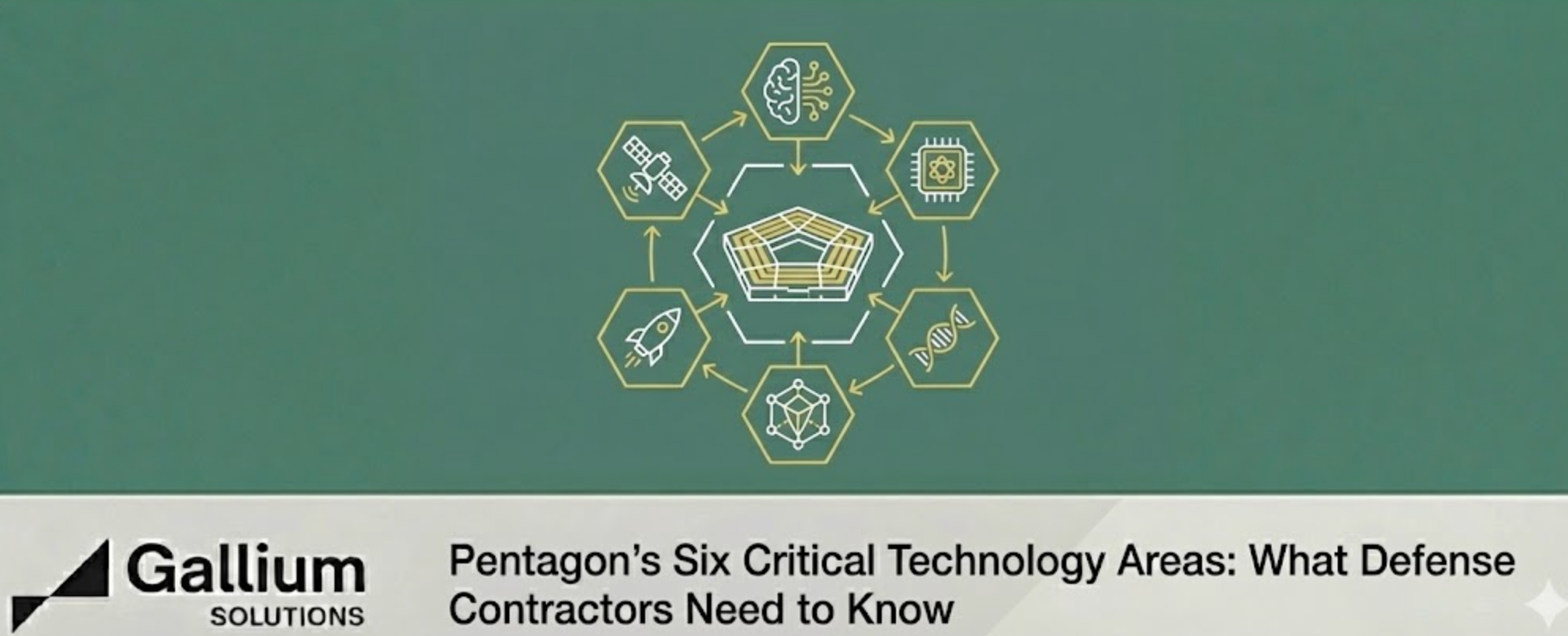
The Department of War has announced a strategic shift in its research and development priorities, narrowing its focus from fourteen technology areas to six Critical Technology Areas (CTAs). This decisive move, unveiled by Under Secretary of Defense for Research and Engineering Emil Michael, represents a concentrated effort to accelerate innovation and deliver cutting-edge capabilities to the warfighter faster than ever before.
For defense contractors and technology partners like Gallium Solutions, understanding these six CTAs is essential to aligning capabilities with DoW priorities and positioning for future opportunities.
Why the Shift?
"Our adversaries are moving fast, but we will move faster," stated Under Secretary Michael. "The warfighter is not asking for results tomorrow; they need them today. These six Critical Technology Areas are not just priorities; they are imperatives."
The consolidation from fourteen to six technology areas reflects the urgent threat environment and the need for focused, rapid deployment of advanced capabilities. This streamlined approach eliminates overlap, concentrates funding, and enables faster technology transition from lab to battlefield.
The Six Critical Technology Areas
1. Applied Artificial Intelligence (AAI)
Applied AI tops the list as the DoW commits to becoming an "AI-First" organization in alignment with President Trump's Artificial Intelligence Action Plan. This CTA focuses on transforming decision-making processes and enhancing overall operational efficiency across all military functions.
Key Focus Areas:
- Intelligence synthesis and analysis
- Enterprise-level transformation
- Warfighting system integration
- Autonomous systems and decision support
AI will fundamentally reshape how the military processes intelligence, manages logistics, and deploys weapon systems, making it a cornerstone of future defense capabilities.
2. Biomanufacturing (BIO)
Biomanufacturing leverages living systems to enhance supply chain resilience and eliminate vulnerabilities. This emerging field represents a revolutionary approach to manufacturing that could transform how the military produces materials, pharmaceuticals, and specialized components.
Strategic Value:
- Supply chain independence
- On-demand manufacturing capabilities
- Enhanced resilience in contested environments
- Reduced reliance on foreign suppliers
3. Contested Logistics Technologies (LOG)
Modern warfare requires the ability to operate and resupply forces in austere, denied, or contested environments. This CTA addresses one of the most pressing challenges facing military operations today.
Critical Capabilities:
- Advanced supply chain management
- Autonomous resupply systems
- Operations in degraded environments
- Resilient logistics networks
4. Quantum and Battlefield Information Dominance (Q-BID)
This dual-focus CTA combines quantum computing capabilities with battlefield communications to ensure warfighters can move freely and communicate securely, even in degraded or denied environments.
Technology Integration:
- Quantum-resistant cryptography
- Secure battlefield communications
- Enhanced information sharing
- Position, Navigation, and Timing (PNT) alternatives
5. Scaled Directed Energy (SCADE)
Directed energy weapons, including high-energy lasers and high-power microwave systems, are transitioning from concept to deployable capability. The emphasis on "scaled" deployment indicates the DoW's commitment to fielding these systems across the force.
Weapon Systems Development:
- High-energy laser systems
- High-power microwave weapons
- Counter-UAS capabilities
- Accelerated R&D to fielding timelines
6. Scaled Hypersonics (SHY)
Hypersonic weapons represent a game-changing capability for both offensive and defensive operations. Like directed energy, the focus on scaling indicates a move beyond prototypes to operational deployment.
Development Priorities:
- Offensive hypersonic weapons
- Hypersonic defense systems
- Accelerated testing and evaluation
- Production-ready systems
What This Means for Defense Contractors
The consolidation to six CTAs signals several important shifts for the defense industrial base:
Focused Investment: With clearer priorities, DoW funding will be more concentrated, creating opportunities for companies with expertise in these specific areas.
Speed to Market: The emphasis on rapid delivery means the traditional acquisition timeline is being compressed. Contractors who can demonstrate rapid prototyping and quick transition to production will have a competitive advantage.
Cross-Functional Integration: Many of these CTAs intersect and complement each other. Solutions that integrate multiple technology areas (such as AI-enabled contested logistics or quantum-secure battlefield communications) will be particularly valuable.
Public-Private Partnership: The initiative emphasizes unprecedented coordination between DoW, private industry, and allied militaries. Companies that can facilitate these partnerships and bring commercial innovation to defense applications will be well-positioned.
Positioning for Success
At Gallium Solutions, we're closely monitoring these technology priorities and aligning our capabilities to support DoW's mission-critical objectives. Whether you're developing AI algorithms, advancing quantum technologies, or engineering next-generation systems, understanding these six CTAs is essential for strategic planning and business development.
The message from the Pentagon is clear: the time for incremental progress is over. The warfighter needs advanced capabilities today, and the defense industrial base must rise to meet this challenge.
As Under Secretary Michael emphasized, "These six Critical Technology Areas represent the priorities that will deliver the greatest impact to ensure that our warfighters remain unmatched in their ability to defend freedom and secure peace."