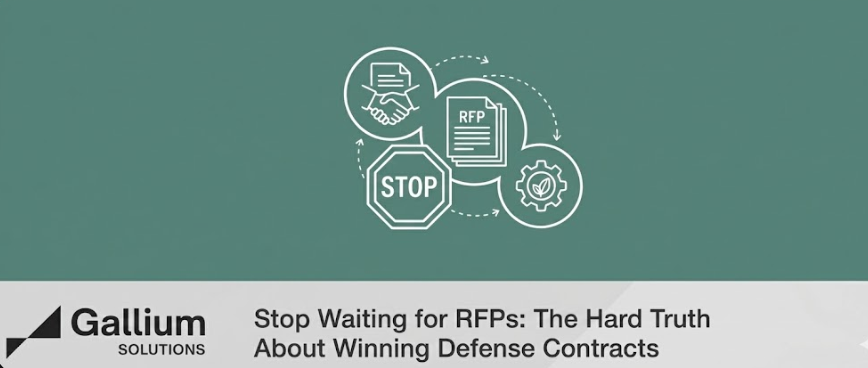
Stop Waiting for RFPs: The Hard Truth About Winning Defense Contracts
In the world of government contracting, there is a hard truth that many teams ignore until it’s too late: The RFP release isn't the starting gun. It’s the finish line.
For decades, the standard playbook for many Defense contractors has been reactive.
You set up your keyword alerts on SAM.gov. you wait for a solicitation to drop, and then you scramble to assemble a proposal team. You work nights and weekends to submit a compliant bid, only to find out months later that the contract went to a competitor who seemed to have the inside track.
The reality?
They didn’t just have the inside track. They helped build the track.
As we look toward the 2026 Defense landscape, the market is becoming faster and more complex. If your strategy relies on waiting for public notifications, you are already behind. To win next year, you need to shift your strategy "left", identifying opportunities and engaging customers long before the requirements are written in stone.
The Problem with "Reactive" Growth
The biggest issue with relying on public solicitation portals is that everyone has the same information at the same time.
When an RFP hits SAM.gov, the government has likely already spent months (or years) defining the problem, researching solutions, and talking to industry experts. If you weren't part of those early conversations, you are bidding against an incumbent or a competitor who helped shape those requirements to fit their specific capabilities.
Reactive bidding forces you to compete on price rather than value, because you haven't had the time to educate the customer on why your specific approach is superior.
How to "Move Left" (Identifying Demand Signals)
So, how do you find out about opportunities before they are public? The answer lies in Open Source Intelligence (OSINT).
Before a requirement becomes a contract, it exists as a "demand signal." These signals are everywhere, but they are buried in noise. They appear in:
- Congressional budget hearings
- Military strategy documents and white papers
- Conference transcripts
- News articles about emerging threats
Historically, finding these signals required an army of analysts. Today, advanced AI tools are changing the game. We are seeing a shift where successful growth teams use AI to scan the entire defense ecosystem for these signals.
Instead of waiting for a solicitation for "drone batteries," they are finding early reports of a specific unit struggling with power management in cold weather. That is the signal. That is the opportunity to engage.
Turning Intelligence into Influence
Identifying the opportunity is only step one. Step two is Shaping.
Once you identify a demand signal, you don't wait. You engage. This is where a strong proposal and capture strategy comes into play.
- Submit White Papers: Don't wait to be asked. Send a white paper outlining the problem (which you found via intel) and your solution.
- Respond to RFIs: Sources Sought and Requests for Information (RFIs) are not just administrative hurdles; they are your chance to tell the government what is realistic and what isn't.
- Meet the Customer: Use your intelligence to ask for a meeting about a specific problem they have, rather than a generic capabilities briefing about who you are.
The 2026 Outlook
The Department of Defense is looking for speed and innovation. They are using Other Transaction Authorities (OTAs) and rapid acquisition vehicles more than ever. These vehicles favor companies that are proactive, visible, and solution-oriented.
If you want to grow your footprint in 2026, stop staring at SAM.gov waiting for a miracle. Start looking at the data, find the demand signals, and help your customer define the solution.
By the time the RFP drops, you shouldn't be introducing yourself, you should be confirming what they already know: that you are the best choice for the job.