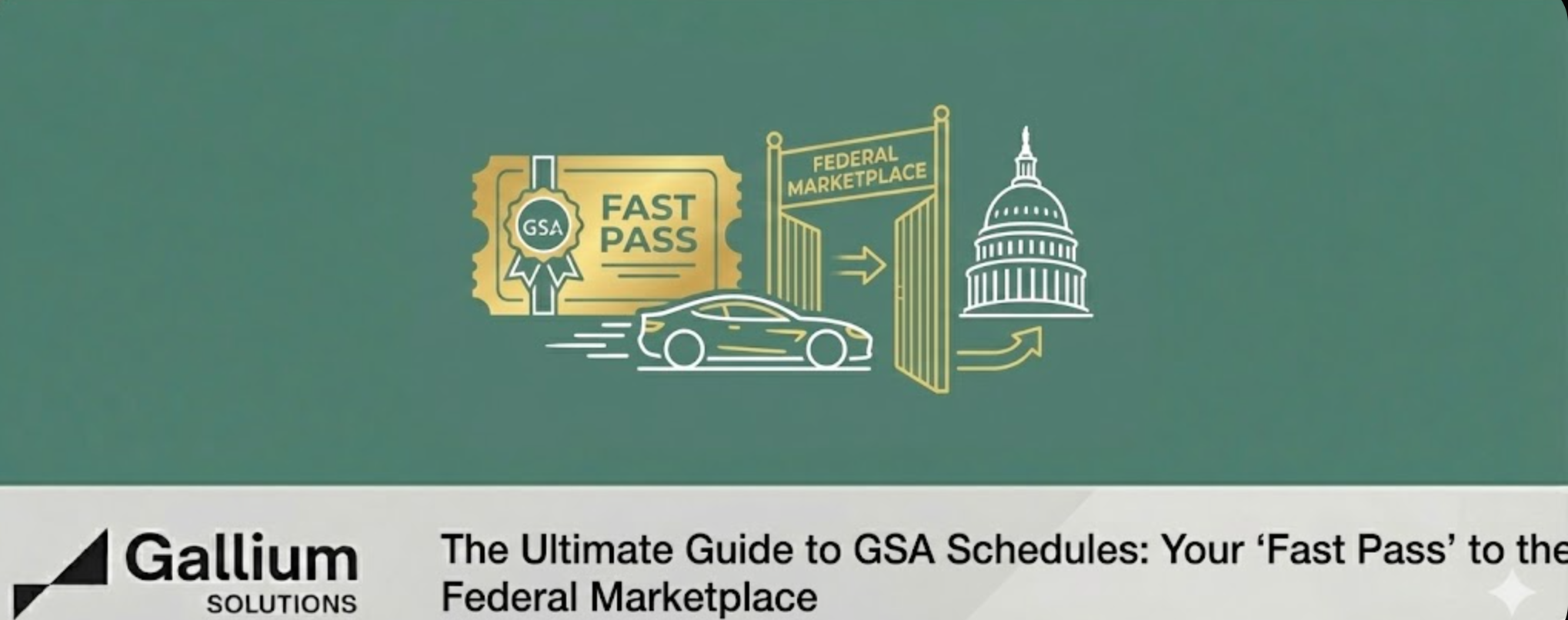
The Ultimate Guide to GSA Schedules: Your "Fast Pass" to the Federal Marketplace
In the world of government contracting, there are two ways to sell:
- The "Kitchen" Method (Open Market): You find a public solicitation on SAM.gov, write a 50-page proposal, compete against 200 other companies, and wait 9 months for an answer.
- The "Menu" Method (GSA Schedule): You get pre-approved on a government shopping list. When an agency needs what you sell, they point to the menu, order it, and you get paid in weeks.
The "Menu" is the GSA Multiple Award Schedule (MAS), and for successful government contractors, it is not optional, it is the foundation of their revenue.
This guide covers everything you need to know about getting, managing, and profiting from a GSA Schedule.
What is a GSA Schedule?
Technically, it is called the Federal Supply Schedule (FSS) or Multiple Award Schedule (MAS).
Think of it as a long-term IDIQ (Indefinite Delivery, Indefinite Quantity) contract. It acts as a "license to hunt." It does not guarantee you money, but it gives you the right to compete in a restricted, VIP marketplace where the sales cycles are shorter and the competition is lower.
- Contract Length: 5-Year Base Period + Three 5-Year Options (20 Years Total).
- Who Can Buy: All federal agencies, plus some state/local governments (for IT and Disaster Recovery).
Why Do You Need One? (The 4 Core Benefits)
1. Reduced Competition
On SAM.gov (Open Market), you might compete against thousands of companies. On the GSA Schedule, you only compete against other Schedule holders within your specific Special Item Number (SIN). This drastically increases your "Win Probability" (Pwin).
2. Speed to Award
Agencies love GSA Schedules because they are fast. Buying on the open market can take 6–12 months. Ordering off a GSA Schedule can take 2–4 weeks. If you want to be the "easy button" for your government client, you need a Schedule.
3. Pre-Vetted Pricing
The GSA has already determined your prices are "fair and reasonable." This means the Contracting Officer (CO) doesn't have to do a deep audit of your rates every time they buy from you. It removes friction from the sale.
4. GSA Advantage! & eBuy
Once awarded, you gain access to exclusive systems:
- GSA Advantage!: Think "Amazon for Government." You list your products, and Contracting Officers can buy them with a government purchase card (GPC).
- eBuy: An exclusive bid board where high-value opportunities are posted only for Schedule holders.
The "TDR" Revolution: Why It’s Easier Now
Historically, the biggest barrier to a GSA Schedule was the Price Reduction Clause (PRC). You had to promise the government your "lowest commercial price," and if you ever gave a discount to a commercial client, you had to lower your government price immediately. It was a compliance nightmare.
That has changed.
Most contractors can now opt into Transactional Data Reporting (TDR).
- No Price Reduction Clause: You can discount commercially without triggering a government price drop.
- No Commercial Sales Practices (CSP) Disclosure: You don't have to reveal your private commercial margins.
- The Trade-Off: You simply report your federal line-item sales data to the GSA once a month.
💡 Gallium Insight: If you are applying for a Schedule today, TDR is almost always the superior strategic choice. It significantly reduces your audit risk.
The Roadmap: How to Get a GSA Schedule
Getting a Schedule is a rigorous process that typically takes 4–6 months. Here is the workflow:
Step 1: Readiness Assessment
Before you start, you must meet the "Go/No-Go" criteria:
- 2 Years in Business: (Unless you qualify for the "Startup Springboard" program).
- $25,000 in Revenue: You must show you have sold your product commercially.
- Financial Stability: Positive cash flow or strong backing.
Step 2: The Proposal Submission
This is not a marketing brochure. It is a technical data package including:
- Financial Statements: Balance sheets and income statements.
- Technical Proposal: Corporate experience and quality control narratives.
- Pricing Proposal: Supporting invoices to prove your rates are market-standard.
Step 3: Negotiations
A GSA Contracting Officer will review your offer and challenge your pricing. This is the critical phase. If you negotiate poorly, you will be stuck with low margins for 20 years.
- Warning: The GSA’s goal is to get the lowest price. Your goal is to protect your margin.
Step 4: Final Award & eLibrary Listing
Once signed, you receive a GSA Contract Number. You are now listed in the GSA eLibrary, and you can legally put the GSA logo on your website.
Maintaining Your Schedule (The "Use It or Lose It" Rule)
A GSA Schedule is an asset, but it requires maintenance.
- Sales Minimum: You must generate $25,000 in sales within the first 24 months, and $25k per year thereafter. If you don't, the GSA will cancel your contract.
- Industrial Funding Fee (IFF): You must pay a 0.75% fee back to the GSA on all sales. (Note: You bake this fee into your price, so the government customer pays it, not you).
Is Your Business Ready for a 20-Year Contract?
A GSA Schedule is the single most powerful asset for long-term federal growth, but the application process has a 60% rejection rate for first-time DIY applicants.
Don't risk a rejection. Let Gallium Solutions manage the proposal, the TDR strategy, and the negotiations to ensure you get a contract that is profitable, compliant, and built to last.
Schedule a Free GSA Eligibility Audit with Gallium Solutions